THE WALLERS WAY
‘You’re a bit too keen, aren’t you?’ says the farmer, leaning on his gatepost.
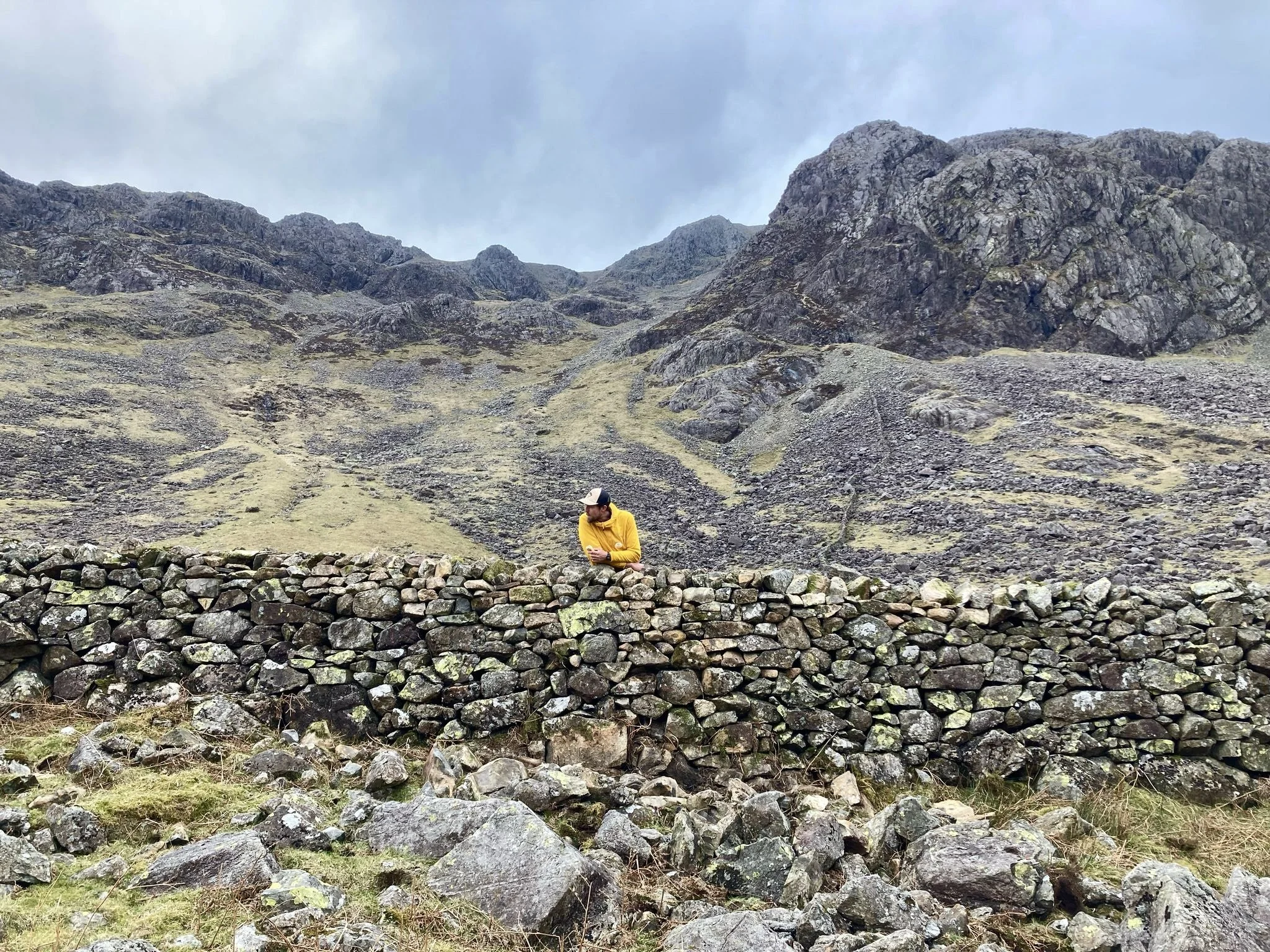
And it’d be hard for me to argue that he’s wrong, standing here in Wasdale half way through a long day, half way round a big month, legs tired and shoulders sore, but offering to do an afternoon’s free work in return for a field corner to camp in.
Though with the spring sun shining above the high fells, and the pub whispering softly to me of pints to be had later in the fading light, there is nowhere else I’d rather be, and nothing else I’d rather be doing, than this.
Keen is probably the word.
__________
After a childhood spent messing about in the woods and being dragged out to walk and camp amongst the Lakeland fells, there was nothing surprising about the way I picked up running: first on the forest paths, then on the mountains. Some people come to fell running from the running. Others come to it from the fell. And although it was a surprise to some (given I was more likely as a child to have my head in a book than my hands on a tool) there was nothing very unlikely about me beginning to work as a waller either: learning on the job on farms near home, so I could spend my time outside, under my own steam, living by my own schedule, and by my own mind.
These two ways of interacting with the landscape – the work and the hobby – gave shape and character to my twenties, and last year, with my thirties approaching, an idea formed in my mind to do something that would celebrate all the ways that both have enriched my life.
And so on the 10th March, I set off from my front door to spend a month running and walling around the Lakes. I had carefully drawn a map which identified what I consider to be every major valley (twenty-six watersheds that felt salient and significant), and I had packed, unpacked, and repacked a carefully chosen bag of kit that would allow me to be self-sufficient as I went (10kg including three or four days food at a time, with arrangements to resupply along the way). The plan was that each morning, I would run from one valley up onto the high fells, and then on down into the next. Each afternoon, I would find a bit of wall to repair. Each night, I would camp. I had a vague idea of which way I was going, but no settled route, and no rules about how far I would go each day, or any expectations of how fast. I would just have to take it as it came. Then, after visiting every major valley in turn, I would arrive back at home on the day before my 30th birthday.
I called it the Wallers Way.
__________
One: Visit every major valley in the Lakes, continuously, on foot, from home, passing over the high fells between each.
I am running. Not walking, shuffling, jogging… but running. Quickly, downhill, skittering over scrubbed-off scree, my feet wheeling like the blades of a push lawnmower, desperately trying to turn and slice at the ground quick enough to keep me from tripping and bouncing headfirst down 3000 feet of fellside to the lakeshore.
Skiddaw has many angles of approach, and countless more detractors willing to whinge about most of them. But the skiddy path off the western flank to Carl Side, followed by a bound down Longside Edge and over Ullock Pike, is truly a fell runner’s line. Rough enough for fun, smooth enough for pace, short enough for energy, long enough for rhythm.
I feel strong and light. Like a child running around in the playground, giddy and carefree. After 10 days of moving, I can feel that instead of grinding me down, as I’d worried that it would, this adventure is beginning to build me up, as I only dared hope it might. The rucksack is heavy enough to notice while slogging uphill, but light enough keep going with all day. I am starting to realise that not only will I be able to finish the thing, but instead of my pace being whittled away to a trudge, the joy might just stay all the way.
Strange thing about walling and running. They seem to draw from different pools of energy. It’s like your savoury stomach and your sweet stomach. You can be full to bursting after dinner, but when the topic of pudding is broached, well… suddenly there’s a bit of room there after all. How often have I felt worn out after a day’s work, only to put on running shoes and feel a sudden spring in my step. Walling is a heavy thing: it leaves your mind free and light, but it weighs down the body. Running is a light thing. I leap out of that stony heaviness, and into a world of springiness.
On the road, running beats out a metronomic rhythm. In the mountains, it carries infinite variety. You must play a wild tune: now up-tempo, now down, quickening your steps to dance over sharp rocks, lengthening your stride to lollop down steep slopes, weight forward to not slip, arms flailing for balance, open and wide in the great wide open.
Each footstep has consequence for the next dozen, so attention is needed. But not too much thinking. This is a doing game. A flowing game. A feeling thing.
__________
As I went on my Way, the days fell into some kind of pattern that felt enjoyable and sustainable: about four hours of running (occasionally quite quick, often at a gentle plod, sometimes slowing to a walk), followed by about three hours of walling. Most of the running I did alone, but over the course of the trip (and on the majority of days, for at least a part) I enjoyed the company of dozens of friends, who kept my mind sane and my heart light.
Seizing the opportunity to explore, I incorporated as many new (to me) or unusual routes as I could between the places I knew well, and also tallied up somewhere between fifty and a hundred summits, depending on who’s list and who’s criteria you favour. I went forward about 600 kilometres (370 miles), and went up about 30,000 metres (98,000 feet).
I climbed Grasmoor in a dense dawn clag with two friends in tow, all of us wondering if the gloom would persist all day. Just as all hope of a view was lost on the summit and a disappointed descent began, the curtains drew back in whisps and rushes, breaking into a rolling topography of clouds for us to whoop and scamper through all the way down into Buttermere.
I explored Whitbarrow in the evening sun, the steep, bone-dry, knee bending climb up its western face feeling positively Mediterranean, all knobbly limestone and crunchy grass.
I strode over the stony summit of Fairfield with friends on the final evening, having ditched the big bag at camp and headed up to soak in the golden silhouette of everything I'd already gone across, and was pleased.
__________
Two: Repair or build a bit of dry stone wall in every valley in the Lakes, to a high quality, matching the local style.
Stone. Stone. Stone. One on top of another. Trying my best to select well, and imploring each to work together with its neighbours in silent harmony. Looking for interlocking shapes, for surface contact, for them all to clasp their fellows in a firm embrace, and never to let go. At least, not in my lifetime.
This is a rough little dale, Far Easedale, and I am high up, redrawing its edges: the lines where pool-table-green-pasture cede to the fuzzy mottle of open fell.
The stones here are large, and heavy – lumps of mineral oozed out by volcanoes eons ago, dragged and knocked and worn away by the passage of land and time, until they were picked up from where they lay by farmboy hands, and carried and placed among throngs of their peers, stacked and packed together in a long, tall fortress of stone. A mighty little thing made by people, from the land.
Each stone you place creates consequences for the stones that come after it. So you have to anticipate what this shape, and the way it lies, will demand of the next shape, like a chess player anticipating the impact that this move will have for dozens of moves ahead. You can get yourself in a tight spot by not paying attention. Making problems for yourself later on, stalling the procession of stone. So it’s important to look ahead, but not really to think about it.
This too, is a doing game. A flowing game. A feeling thing.
__________
I don’t know if anybody else has walled in every valley in the Lakes, but I doubt it. For most of the history of walling, in most places, the work was done by local farmers, or (later, in the era of the enclosures) by hired gangs who would spend months camping out on the fellside, putting up many metres a day. It takes a modern sensibility to turn such simple hard graft into something that you might want to do for any reason other than a wage: for peace and satisfaction, too.
But walling can be as much a careful work of craftsmanship as any other trade, and part of the idea of this trip was to act as waller’s rite of passage, inspired by the traditional 'journeyman' phase that craftspeople across Europe used to take to gain breadth of experience through working travel. A few of the bits of wall I did on the Way were pre-planned, and for a few I knocked on a farm door there and then to ask permission, but most of them were just done whenever I found a suitable-looking repair each day, because I wanted to have the freedom to choose exactly where, when and how to do them. Show me a farmer who’s angry with a bit of wall being repaired to a professional standard for free, and I’ll show you a liar.
Most of the walls I did alone, but on a few days I had the company of five equally 'too keen' waller mates, without whom the whole adventure would not have been the same. All the work was done without any tools - just hands. I like to say that you could wall naked. Not that you should, obviously (all manner of things might get trapped in ways you would not wish for…), but the point being that tools and gear are optional.
And as well as doing a bit of wall in each valley, I was also eager as ‘side quests’ to try and get my hands on all the different main stone types in the Lakes (Eight key ones, including different varieties of slate, volcanics, granites and limestone), and also wedge in as wide a variety of types of wall as possible. The thirty walls I did included steep fellsides, sheepfolds, ends, boulder footings, curves, retainers, cairns, a corner and a bole.
I pried stones out of the ground with feverish ambition on the slopes of Grisedale, under the looming presence of St. Sunday, searching for enough pieces to complete the curved end of a superb circular sheepfold set back above the path.
I found a ram’s skull behind the wall in Matterdale, and incorporated it into a feature inset alcove in the repair, christening it the ‘Tup Bole’, and framing it with pieces of bright red Mell Fell conglomerate sandstone, unlike any other stone in the Lakes.
I left behind one of my best pieces of work on the Castle How wall in Little Langdale, on ground where people have lived and farmed since the Iron Age.
__________
Three: Sleep overnight in every valley in the Lakes, mostly out in the open, or in rough shelters.
It is cold. Cold to the bone. So cold that I have to get up for a third time and sprint up and down the fellside, bright moon hanging above me in icy indifference, and all the stars winking their support, or perhaps their derision… it’s hard to tell. Between the dying red ember of sunset and the bright spark of sunrise, these endless hours in the bag aren’t offering much recovery from the long day earlier on. Rest of a sort, perhaps, but not sleep, not really.
One more lap, I decide, and set off back down the trod at pace, before retreating to the bivvy to spent a few more hours regretting my serious down-bag-fill-power optimism.
And then finally, it is dawn. The eastern rays unfurl across the Eden valley and up the flanks of Carrock to my stone shelter, bringing with it the start of spring. The vernal equinox.
__________
Mostly, I camped: seven nights in the tent, six nights in the bivvy bag, and three nights in caves. Three nights in bothies, three nights in barns, one in a hostel, one in a bunkhouse, and one at a friend’s house. I could have done it all on day-trips from home, of course. But in the end, the camping was integral to the feel of the thing, because it created a 'big' atmosphere even while I was never more than a couple of hours away from home. Sleeping out always feels like an adventure, and having with you everything you need to make a bed anywhere is liberating.
I saw lots of mates on different evenings, often accompanied by some great food to save me from a tedious camping diet, logs for bothy fireplaces, a few beers or a nip of strong stuff. It was all just a glorified birthday party, after all! And despite the general rough sleeping, no pretensions of wilderness purity were countenanced: eight pub stops also featured. Five out of the eight nights with company were graced by snorers, none of whom are my friends anymore.
I sat beneath the Milky Way in Crookdale, drinking hot chocolate, when a pale shape descended from the blackness. The barn owl alighted on a post just beside me and turned to gaze at me for a moment, before swooping away again in search of small creatures to devour.
I crawled beneath the boulder jamb at Woofstones, and stared up at the rock inches above me in the cool still dark, surrounded by old biscuit tins full of visitor book scraps of paper, and the odds and ends of years of subterranean guests.
I listened to the rustle of sheep in the lamb adopter in a friends barn in Rusland, wriggling around on the haybales to find a the comfiest spot to sleep.
__________
On the 4th April, I trotted gently back along the road to my house with Rose, completing the Way. I was very pleased. Then, after three days of rest, I returned to my normal work. Walling. And of course, after work, I went for a run. Ordinary. And if that day was ordinary, then the month was ordinary too. Just more days of living. But how potent ordinary can feel, when beauty is not the exception, but the very eyes through which we see our existence, the hands through which we feel our lives, the feet through which we move through the world.
I grew up in Lakeland, and I know it well. But there is always more to explore from your doorstep, no matter where you’re from, and always more belonging to be found, no matter where you find you belong.
__________
This essay was originally written for The Fellrunner - the journal of the FRA - for Issue 142 (Summer 2025). Many thanks to Tory Miller for publishing.
Bobby Gard-Storry
Cumbria, 2025